
RV & Camper Van Body Repair in Austin, TX
A camper van is a body-and-paint problem sitting on top of a house. We repair the vehicle - structure, panels, roof and finish - and we are straight with you about where our work stops and your conversion builder's begins. Our paint booth door is 11 feet 6 inches, so most of them come inside.
Most body shops are not set up for a camper van, and most RV dealers are not body shops. That gap is why a damaged Class B tends to sit for weeks while the owner is told to call someone else. Luxury Auto Body works on the vehicle side of it: collision damage, hail, structural work, roof and panel repair, and refinishing - on the same chassis we already repair every week as commercial vans.
This page is about Class B camper vans and van conversions - the ones built on a Mercedes-Benz Sprinter, Ford Transit or Ram ProMaster. Those are the same vehicles covered on our commercial and Sprinter pages, with a house built into the back.
Our numbers, so you can measure yours against them: bay doors 18 feet tall, paint booth doors 11 feet 6 inches tall. A high-roof Sprinter conversion is a little over nine and a half feet with nothing on the roof - but an air conditioner, a fan or a roof rack adds to that, so measure to the tallest thing up there, not to the roofline. If you are close to the number, or your rig is longer than a van, call and we will work it out before you drive across town.
Call (512) 986-7327 for Austin or (512) 572-5245 for Round Rock, Monday through Friday. Send photos and tell us the chassis, the converter and the overall length, and we will tell you where you stand.
Which RVs We Can Take, and Which We Cannot
This is the question everyone opens with, so here is the answer before anything else. Our paint booth doors are 11 feet 6 inches tall and our bay doors are 18 feet. Those are measured heights, not estimates.
A Class B camper van - the ones built on a Mercedes-Benz Sprinter, Ford Transit or Ram ProMaster - typically stands 8 to 10 feet. It comes inside, and the whole vehicle is our work: body, structure, roof and paint.
A Class C, the one with the bunk over the cab, typically runs 10 to 12 feet, which means some clear our booth door and some do not. Two things decide it. First, height - measure yours. Second, scope: the cab and chassis of a Class C are ours the same way a box truck cab is, but the house body bolted on behind it is a separately manufactured body and a different trade, exactly as we describe on our box truck page.
A Class A, the bus-shaped ones at 12 to 14 feet, does not fit in our booth. We will tell you that on the phone rather than let you drive over.
If yours is close to the line, measure to the tallest thing on the roof - the air conditioner, the fan shroud, the solar rack - not to the roofline. That is the measurement that decides it, and it is the one most people get wrong.
Texas Hail and a Very Flat Roof
A Class B presents a hailstorm with a large flat high roof and two tall flat sides. It is close to the worst possible shape, and Central Texas gives it plenty of opportunities.
On a work van, hail is cosmetic until it rusts. On a conversion it is not, because that roof carries sealed penetrations for the air conditioner, the fans, sometimes solar. Hail that disturbs the sealant around one of them starts a leak you will not see from outside, and the first thing you notice is soft cabinetry a season later. That is why we treat camper hail as its own repair path rather than a dent count.
If your van has taken hail, photograph the roof as well as the sides before anything is cleaned or moved, and get the claim opened. Hail claims are usually straightforward; the damage that gets missed is almost always overhead.
Before You Bring It In
Five minutes of this saves days later, and most of it you can do from your driveway.
- Measure the overall height to the tallest thing on the roof, and the overall length. Those two numbers answer the fit question on the phone.
- Photograph the damage, the panels either side of it, and the whole roof - in daylight.
- Bring the build documentation, or tell us who converted it. What is inside the wall decides how we open it.
- Tell us what is on the roof and where it is: air conditioner, fans, solar panels, antenna, awning rail.
- Tell us about the battery bank and roughly where its wiring runs, so the work is planned around it from the start.
- Empty the fresh and waste water tanks if you can. Water is weight, and weight matters on a lift.
- Tell us if you have a trip booked. It changes what we order first.
What Is Behind That Panel Is Not Empty
This is the single biggest difference between a camper van and a cargo van, and it is the reason a shop that treats them the same causes damage that was not there before the repair.
On a cargo van the inside of a side panel is bare metal and insulation. On a conversion, the same space can carry twelve-volt and shore-power wiring, water lines, a propane run, a heater duct, or the mounting for a cabinet that is structurally tied to the wall. Drilling, welding or pulling a panel without knowing what is behind it is how a straightforward dent turns into a water leak or an electrical fault two months later.
So we ask first. Bring the conversion's build documentation if you have it, or tell us who built it. Where we cannot establish what is behind the work area, we open it carefully and look rather than assuming - and if that adds time to the estimate, we would rather tell you up front than explain it afterward.
Roof Damage Is a Water Problem, Not a Cosmetic One
A camper van roof is full of holes on purpose - an air conditioner, a fan or two, solar panels, sometimes an awning rail down the side. Every one of those is a sealed penetration, and every one is a place water gets in once the surface around it is disturbed.
That changes how roof and upper-panel damage has to be handled. On a work van, a dented roof is cosmetic until it rusts. On a conversion, the same dent can break a seal you cannot see from outside, and the first symptom is soft cabinetry a season later. Water intrusion is what destroys campers, far more than collisions do.
Central Texas hail makes this a live issue rather than a hypothetical. A Class B presents a large, flat, high roof and two tall flat sides - close to the worst possible shape in a hailstorm. If your van has taken hail, we handle that as its own repair path.
Where Our Work Stops
We would rather draw this line clearly than take your van in and hand it back half-solved.
We do: collision and structural repair, panel replacement and alignment, roof and upper-body repair, hail repair, rust and corrosion work, and refinishing in our own downdraft paint booths.
We do not: propane systems, plumbing and water tanks, appliances, house electrical, solar arrays and battery systems, cabinetry, or interior finish work. Where a repair runs into any of those, we stop, tell you, and coordinate with your converter or your RV service shop rather than improvising on a system we are not the right people to touch. Tell us at the estimate what is installed - particularly a large battery bank and where its wiring runs - so the work can be planned around it safely from the start.
We also do not produce wraps, decals or graphics in house. Where artwork has to come off, we note it on the estimate so replacing it is part of the plan.
Insurance, Value and Timing
A camper van is usually insured differently from a car, and often for a great deal more money. We work with all major carriers and bill them directly, and we are a State Farm Select Service shop. We do not accept Fred Loya or Alinsco claims.
Get the estimate in writing before you decide anything, and read your own policy or call your agent on how your van is valued - a conversion can be worth well beyond the base vehicle, and that is between you and your carrier, not something we will guess at for you.
On timing: tell us if you have a trip booked. It does not always change what is possible, but it changes what we order first and how we sequence the work, and it is the kind of thing that is useless to mention after the fact.
The Same Chassis, Every Week
Sprinter, Transit and ProMaster vans are routine work here. A Class B is that vehicle with a house in the back - the body and paint side is not unfamiliar territory for us.
We Ask Before We Cut
Wiring, plumbing and propane runs live inside the walls of a conversion. We establish what is behind the work area rather than assuming it is empty.
Refinished On Site
Large flat van panels are the hardest thing in a body shop to refinish convincingly. We do it in our own downdraft booths, under our own warranty, not at a subcontractor.
An Honest Boundary
Body, structure, roof and paint are ours. Propane, plumbing, appliances, solar and house electrical are not, and we will tell you that before we take the vehicle rather than after.
The Chassis Yours Is Probably Built On
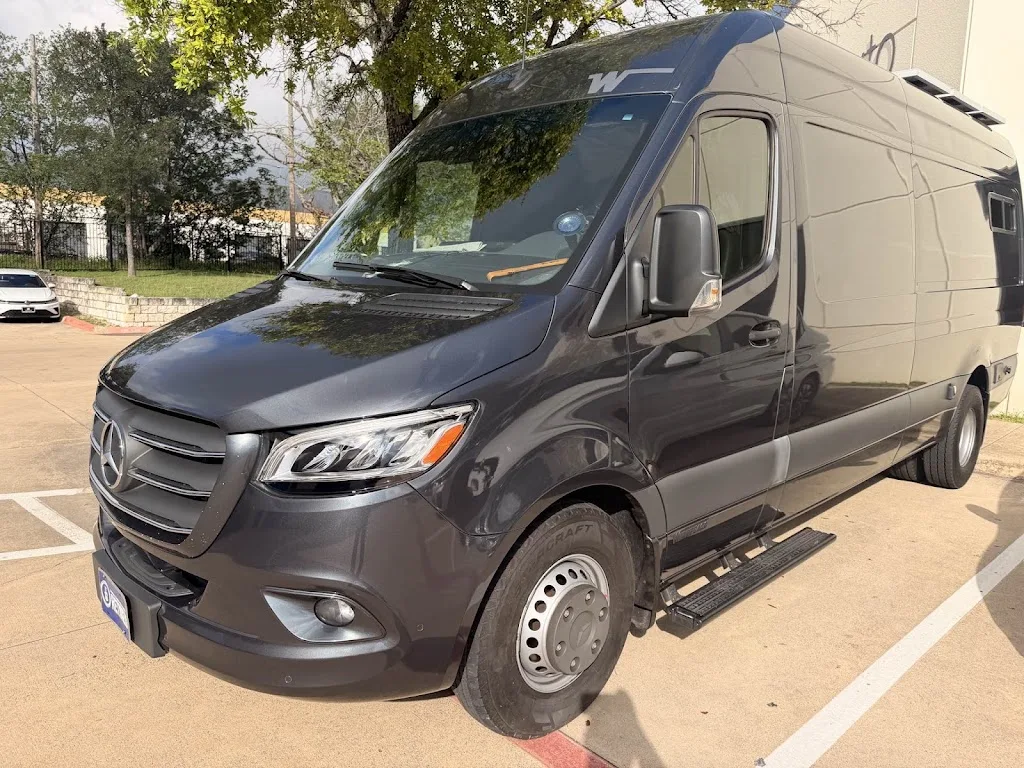
This is a high-roof, extended-length Mercedes-Benz Sprinter we repaired after front-end collision damage. It is the same chassis most Class B conversions are built on. Photographed on intake and again once the repair was finished — our own work, not a stock photo.
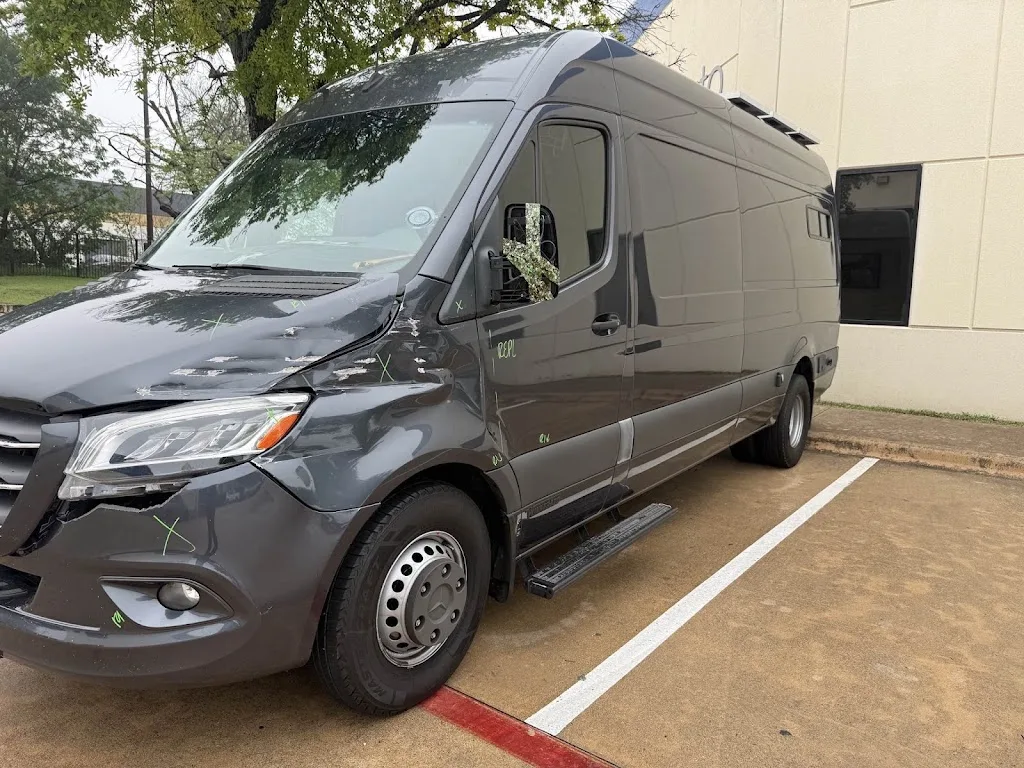
Front-end collision damage on a high-roof Sprinter — headlight, grille, bumper and front fender. Photographed on intake and again in the same parking bay when the repair was finished.
Who to Call for the Rest
Telling you what we will not touch and then leaving you to figure out the rest is not much of an answer. These are established Central Texas businesses that do the work we do not.
We have no arrangement with any of them and we are not paid if you call them. The list is here because it is genuinely useful, and because we would rather you get your rig fixed properly than have us pretend we do all of it.
Whoever built your conversion
For cabinetry, interior finish, and the systems that came with the build, the converter who did it is almost always the right first call.
- Sportsmobile · Austin · Class B conversion builder, building since 1961
- Highland Vans · Serves Austin · Sprinter, Transit and ProMaster conversions
House systems, and anyone who will come to you
Air conditioning, water heaters, plumbing, appliances, awnings, slide-outs, solar. Mobile techs handle most of it in your driveway.
- Central Texas Mobile RV Service · Austin · RVIA certified, mobile within about 100 miles
- Mobile RV Repair of Austin · Austin metro · Electrical, plumbing, appliances, roof and awning
- Heads Up RV · Spicewood · AC, furnace, slide-out and roof repairs
Dealers, parts and warranty work
For warranty claims, parts, and service that has to go through a dealer.
- Crestview RV · Buda & Georgetown · Four Central Texas locations
- Ron Hoover RV & Marine · Georgetown · Family-owned since 1987
- Princess Craft RV · Round Rock · Truck campers and light trailers, parts and service
Listed for convenience, not as a recommendation of any particular company — check them out yourself the same way you would check us out.
RV & Camper Van Body Repair in Austin, TX — Questions We Hear
Answers reviewed by Luxury Auto Body.
Bring it in — your estimate is free, with no obligation.
Call or request a time that works for you. We inspect the damage, document it for your insurer, and walk you through what happens next.
Prefer to book online? Pick a time via Carwise